Once per session, when you introduce a fact or narrative detail from your past life, it affects the fiction immediately, no roll required. It must be related to your Class, not the Dragon. The DM and other players can ask you to adapt it.
13 min read
Why Would You Fight a Dragon?
tldr: I wrote a small game kinda by accident. get it on itch.io
❦
I signed up to run 1 HP Dragon at a convention in a <2 hour time window with hotseat. Yeah… Pulling off something good in less than two hours, while your players can join later or leave in the middle requires effort…
I need something accessible, fast and small.
I feel like you could play 1 HP Dragon as a standalone ruleset, with no dice, just with:
If you can do it, do it.
If you can't do it, plan better or do something else.
Many players come to the hobby because they like the dice. They like how the randomness and game mechanics help us tell stories more interesting than we’d be able to tell without them.
So, some dice resolution will be more accessible than no dice. Principle of Least Surprise, huh?
I’m definitely taking a PbtA standard 2d6. Player-facing symmetric dice rolls are fast: no turns, no action economy, DM doesn’t roll. I know it sounds stupid, but assume all dice rolls take constant time to roll, read the result and narrate. This makes us more than I didn't measure anything. Sorry. as fast as D&D!
If it’s PbtA, I’m gonna need some moves. I’m not taking Homebrew World or One Shot World, both really good games that served me well on events, because I won’t have much time for character creation and building the world based on the playbooks.
Mechanics
We’ll play with tiny playbooks. You make up your own Class: “Bard”, “Wyvern Lancer”, whatever. It creates fictional positioning, affecting what you can and cannot do, and once per session it lets you Bellow.
Akin to Blades flashbacks or spending a Fate point to declare a story detail, this lets the Hunters fire a powerful “ultimate” to bite into the Dragon’s Armor, while we learn who they are and where they come from.
A Bard: “I sang for the duke and then we partied way too much. The guy loves me. He’ll help us for sure.”
Instead of paying with a meta-currency, we get it once per game. Fits my 2-hour constraint and leaves me room for meta-currencies I wanna explore later.
We know something about the Hunters’ past, but not why they face the Dragon.
Goals
I wanna focus on the player characters’ connection to their dragon. We call them Hunters and each of them has a Goal: Vengeance, Power, Greed, Glory, Knowledge, Oath.
A Goal can be relinquished, of course. Character development, hell yeah!
When you give up on your original motivation:
- Describe why you forsake your Goal.
- You are visibly changed: the way you walk, your facial expression, a symbol of your previous motivation. Say how.
You may turn one of your rolls into a success now or later.
But even before you get rid of it, the pursuit of it lets you affect the game.
When you chase your Goal with abandon: describe it, push through it, interrupt the DM mid-sentence if need be.
Reroll your die, but raise Pyre.
Pyre
The Pyre is your doom track. Think inverse health pool. Fill the fourth box and you’re consumed, dead or worse.
PyreThe game is about the Dragon, tactical storytelling and problem-solving, sure, but also about the relation of our heroes to the Dragon and what they are willing to sacrifice to defeat it.
Consumed doesn’t mean “out of the game”. If dying is boring, maybe you turn against your friends as corrupted villains or undead servants of the dracolich. The DM will feel responsible for time management, so we leave the exact timing and nature of your fall to them.
This is usually an “opportunity for a cost” moment. Fáfnir was born a dwarf; his greed turned him into a dragon.
That’s goals, the “Why” part of the title. We know something about the “You” part: the Hunters, their Classes, though I don’t think it’s enough. How else do they differ from each other? And how do they “Fight”?
We need some baseline dice resolution, stats and a catch-all move.
Stats
I’m taking 3 stats, Body, Wits and Soul. The Dragon will attack them, dealing damage like -2 Body or -1 Soul. From the perspective of the genre, fighting a dragon is exhausting.
Distribute values from -2 to +2 so that their total equals +1. Ignoring order:
(+2, 0, -1); (+1, +1, -1); (+1, 0, 0); (+2, +1, -2)Body: Physical strength and stamina.\ Wits: Mental acuity and perception.
Soul: Arcane potency and spiritual force.
I’m gonna base the catch-all on Jeremy Strandberg’s Defy Danger, Restated. In
the small little village called Stonetop CC BY-SA 4.0, sharing is caring.
When the stakes are dire, danger is imminent,
and you act anyway, roll 2d6:
- +Body to endure, act fast or with finesse
- +Wits to apply expertise, enact a clever plan, or rely on senses
- +Soul to invoke the arcane, unleash mystical forces, resist esoteric energies
On a 10+, you pull it off as well as one could hope.
On a 7–9, the DM will present a partial success, a tradeoff, or a
complication.
On a 6−, mark 1 XP and the DM makes a move.
Teamwork?
Face Fury is the baseline: you against the obstacle, you against the Dragon. Most often, it won’t be just you. Others will jump in to help or, chasing their own Goals, interfere with your actions.
When you throw yourself in to help another Hunter, reroll their dice. You share the consequences and take −1 Stat to match the danger:
- Body for fire and force
- Wits for lies and madness
- Soul for hex and heartbreak
More than one Hunter can jump in on the same action.
When you interfere with another Hunter’s action, Face Fury.
On 7+ you impose −2 to their roll or diminish their effect. They may stop
what they’re doing and get 1 XP.
On 10+ you also avoid the consequences.
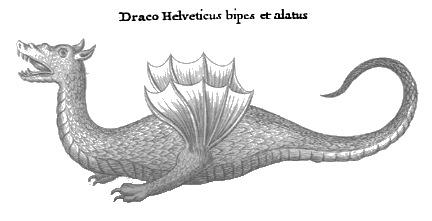
Hard it is to defeat a dragon, but try one must.
from New Athens, one of the first Polish encyclopedias; both quote and illustration, 1745
The Ends
The moves so far trigger when the Hunters act. But what if the dice don’t favor them and the Dragon proves too strong?
When one of your Stats gets to −3 or lower:
Set it to −3 and raise Pyre.
You succumb to your wounds.
You are out of action until helped or until the scene ends.
A downed Hunter goes back up when the smoke clears and the scene ends.
This would be a moment in the movie, when everybody thinks the character is dead. The other Hunters may help, but it will take hours to get them back in action.
Turn to Ash is the sacrifice you don’t choose. Each time you fall in your quest to slay the beast, you take one step towards the end, you’re getting closer to be consumed.
When your Pyre reaches 4 within Turn to Ash, it may mean death. Certainly it’s the easiest interpretation when you hit -3 Body. At -3 Wits, madness. A Wizard at -3 Soul may be hollowed, mana-drained; whereas a Peasant probably just gives up.
In contrast, when you’re consumed by your own choice in Stoke the Fire, it may be betrayal or corruption. Dying to a heart attack because you fought the Dragon too hard isn’t exactly in the genre, so sharpen the knives and watch your back.
❦
Turn to Ash and Pyre is how we go down, but we could use a little bit of going up as a palate cleanser. We also need an XP sink. I love XP-on-Miss: it incentivizes the players to play courageously and embrace setbacks. Let’s see what we can do with that hard-earned XP.
When you have 4 XP or more, and a moment of rest, spend 4 XP to raise one of your stats by +1 (up to +3) or clear 1 Pyre.
The Hunters can use XP to get stronger or postpone their doom. They can also hoard it until the end of the game, until the Aftermath, to affect the world and have more to say in the epilogue.
The Hero’s Journey doesn’t end when the Dragon is defeated. There’s still Transformation, Atonement and Return. Our session time is limited, so instead of playing it out, please forgive me and brace for the longest procedure you’ve ever read in a game.
When the Dragon or the Hunters are defeated:
Take 1 XP if you have defeated the Dragon.
Take 1 XP if you praise another Hunter’s deed. No duplicates.
For each unspent XP you hold, choose one from the following:
- Fulfill your Goal. Describe how getting what you wanted changes your life.
- Clear 1 Pyre. Time and distance heal your wounds.
- Claim a piece of the Dragon that wasn’t destroyed: a Scale, a Fang, a Curse.
Choices are repeatable. If you Relinquished your Goal, describe the life you found in its place.
Then, go around the table once again.
If you’re consumed and dead, name the legend told about you. If you’re consumed, but alive, tell of the desolation you’ve wrought upon the world. Otherwise, for each marked Pyre, another Hunter describes a shadow over your future.
The DM looks at the remaining pieces of the Dragon and narrates their future.
Maybe, even with the Dragon defeated, the story isn’t over? Maybe the Wyrmlings have fled? Maybe someone has come to the battlefield after the Hunters left.
I’d usually cut and zoom out immediately after the Dragon falls. Otherwise some players tend to narrate the parts Transformation, Atonement and Return in an unstructured way, and we risk skipping over the more shy storytellers.
If there is some kind of immediate danger, like the ceiling falling down, the nuclear reactor in the heart of the Dragon exploding or a betrayal by an NPC, please play it. The more Pyre you accumulate during the game, the more satisfying the Aftermath will be.
Initially, Aftermath had the trigger “when the game ends” and asked for Wishes and Highlights, but playing for twenty minutes after the game technically ended was awkward.
I extracted the end of session feedback loop into Raise a Toast.
When the game ends, for the last time, go around the table.
Say one Wish, something that could’ve been handled better or differently, in fiction or at the table; and Highlight one thing you liked in the game.
DM Moves
I’m leaving the DM moves, agenda and principles as an exercise to the reader. Tis but a write-up for people who already played a lot of games. I’m playing this with a list yoinked from Stonetop, because I have it engraved in my brain.
“Reveal an unwelcome truth” creates a new situational armor or tells us something about existing legendary armor. “Hurt someone” allows me to hurt them narratively and burn their stats.
You can use any other list that kinda fits, like the one in MotW or Apocalypse World. Barf forth apocalyptica, if you so please.
The Dragon is by definition big and scary, so feel free to use multiple hard moves at once. Separate and hurt them. Break their stuff and soar into the sky. Or, inspired by MotW: Boast and gloat, revealing a secret and then Escape.
Marking Pyre
I feel like it’d be rude for me, a mere Dragon Minder, to force them to mark Pyre directly. I’d rather attack their stats, then let the Hunters and the dice decide. Instead of falling down the Hunters may say “Hell no, I’m not going down like that!”, do something fun and trigger Stoke the Fire or Relinquish their Goal.
Narrative Structure
Running this at Bazyliszek, I’m basically planning to do a few rounds around the table.
- I tell the players that roleplaying is a conversation with mechanics sprinkled on and that I won’t kick them under the table if they interrupt me.
- Players create and introduce the characters. I ask questions to learn about them and the Dragon.
- I write down its Legendary Armor, Permanent Armor and Lore on post-it notes and put them in the middle of the table.
- We play as usual, solving the Dragon, narrating the actions. I run the core game loop and ask “what do you do” a hundred times.
- We run the Aftermath, the Hunters make their choices, and we narrate what comes next. Did the Knight marry the Princess? Is the Wizard who gave up on his quest for forbidden Knowledge now teaching kids at a school?
The End
That’s basically the game. Well, at least a part of it. Go grab a PDF on
itch.io.
You’ve run stuff, you’ll be fine. Play it, make your Class a “High-school
Teacher” and fight the Dragon of “Late-stage Capitalism”. Or don’t play it, just
yoink what you like and make your own game.
Ideas, complaints, insults or accolades? Mail me all about it. If you get a chance to play, BlueSky me why you fought it and if it was worth it.
❦
Prior Art & Attributions
This is a “DLC” to 1 HP Dragon by Clayton Notestine; Face Fury adapts Jeremy Strandberg’s Defy Danger, Restated, used under CC BY-SA 4.0; and I run the game with the DM moves from his Stonetop or Monster of the Week Keeper moves by Mike Sands. The ruleset in this post is shared under CC BY-SA 4.0. All the images in this article are public domain.
Thanks to my dear friend Zack Thomson for talking it out with me on Discord and helping me come up with something semi-decent.
a ca. 1581 jewelry design by Hans Collaert I depicting Neptune riding a sea-monster
Addendum
- If you’d like to get some more flavor and immersion for the price of lowered accessibility, you can say Build Pyre instead of Raise Pyre and Burn 1 Body instead of Take -1 Body.
Changelog
-
Saturday, July 4, 2026 — After proofreading from Wafergix and Łukasz Bartoszewicz
- Added example names, classes, and looks. It speeds up the character creation, conveys the vibe, and doesn’t cost us anything really. They’ve made a great point.
- They also noticed that without reading the blog post first, the PDF doesn’t explain what consumed means.
- Wafergix noticed that the PDF should advice how many armors for the dragon to create and that maybe we should include an abbreviation of armor/boss rules for the players not familiar with the blog post to skim at the table.
-
Sunday, July 5, 2026 — After the first playtest with players who didn’t read the game before:
- I felt like the the incentive to Stoke the Fire was not big enough. The game turned out well, but I want less chill & more drama, so I’m bumping Relinquish to guaranteed success instead of bumping success level, and trying to figure out a better Stoke the Fire. Rerolling a chosen die is statistically better than rerolling two, but it doesn’t feel impactful.
-
Tuesday, July 14, 2026 — I ran the game thrice on Bazyliszek and twice after it.
-
Changed Jump into Flames to cost -1 Stat and reroll both dice instead of a selected die. Everybody helping in one roll led to a certain success, so I had to either limit the number of people who can help or nerf it. I also ran the games for parties of 5 and 6, what happens on conventions, and the game needs to handle that.
-
The old reroll let you keep your best die, so bumping
[6][1]up to a 10+ cost nothing. You’d never drop below it, and a full table could just grind any roll into a full hit. When we reroll both, a fresh 2d6 can miss, so there’s a risk in rerolling a partial.
-
-
Friday, July 17, 2026 — Playtest 6. First one as a player.
-
We played online, no whiteboard, just talking thru Discord on phones, because my airpods refused to work with the computer. The game is accessible enough for conventions, where everybody gets a copy of it. Unfortunately, it’s not accessible enough for a first-time player to play fiction-first with GM calling moves, and without the list of moves on the whiteboard.
-
I’m adding “When it drops to -3, Turn to Ash” under Stats, so the character sheet itself carries the information. The whole game is the playbook, but I’m gonna make this a desperate move for players who’ll never open it and look just at the character sheet.
-
I’m not sure I’d ever be able to reach the accessibility of games like Homebrew World and One Shot World, because a lot of things I like about this game, like the descent of raising Pyre and grinding down stats is inherently less common and weirder than “If you have more than 1 HP you are ready to go”. I ran dozens (almost a hundred?) oneshots in the tradition of John Aegard’s “Dragonslaying on a Timetable: Running Tight 4-Hour Dungeon World One-Shots With Zero Preparation”. Every oneshot game I run competes for the slot with the aforementioned. Tough competition.
-
I noticed WWYFaD delivers some less common types of fun. The DM is responsible for increasing the stakes, pushing the Hunters and facilitating the fight with the Dragon. They’re not responsible for the setting really, and as it’s meant for oneshots, the players can have a lot of narrative freedom. The freeform class allows players to try new things and express themselves. I’ve seen people write in: Goddess-Sorcerress (dragon’s wife), Maiden-mutant (dragon’s daughter), Tyranosauroid Trickster, Qunari, Despotic Pixie Princess. Today I had a chance to portray a Starfighter Pilot to fight the DRAGON: Distributed Reactive Assembly of Guardian Ordnance Nodes (i.e. a big mech made from other mechs).
-